


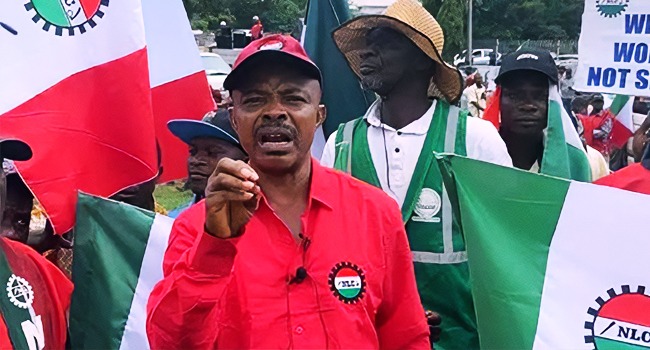
The Nigeria Labour Congress (NLC) has urged the Federal Government to award a cost-of-living allowance and tax relief for workers, to cushion the effects of the recent increase in the price of Premium Motor Spirit (PMS) or petrol caused by the ongoing crisis in the Middle East.
The demands were made in a statement, ‘Save Nigerians From This Shock: An Urgent Relief Has Become Necessary,’ signed by its president, Joe Ajaero, on Sunday.
The Group noted that the petrol price hike had worsened the economic hardship for Nigerian workers and citizens.
The NLC listed its demands as including immediate wage award and cost-of-living allowance (COLA) for all workers to cushion the rising cost of living; expansion and overhaul of the Cash Transfer programme to ensure transparency and guarantee that assistance reaches the most vulnerable citizens, with transfers adjusted to reflect inflation; immediate tax relief for workers, including suspending regressive taxes on low-income earners and taxing the informal sector.
The labour group also accused the government of leaving Nigerians at the mercy of volatile global oil prices triggered by the escalating war crisis.
It alleged that the situation has exposed the fragility of Nigeria’s downstream petroleum sector and deepened the suffering of workers and their families, calling for immediate steps to revive Nigeria’s refineries.
It said the Nigerian state must be held accountable for the billions of naira spent on turnaround maintenance, saying that taxing minimum-wage earners amounts to extortion.
“NLC voices the collective anguish of millions of Nigerian workers who are bearing the brutal cost of a global capitalist crisis they did not create. The military escalation involving the United States, Israel, and Iran has sent shock waves through global oil markets. As a result, petrol prices in Nigeria have skyrocketed to between N1,170 and N1,300 per litre.
“This is a direct assault on the Nigerian people. While imperialist rivalries play out abroad with bombs and military escalation, Nigeria’s working class is being bombarded with poverty and hunger because we have failed to ensure that our public refineries are operational.
“This crisis has brutally exposed the fragility of Nigeria’s downstream petroleum sector. It has stripped away the illusion that local refining alone would shield the country from global shocks. The Dangote Refinery has adjusted its prices in line with global volatility, passing the burden directly to the masses. This undermines the narrative that domestic production alone guarantees price stability.
“As long as Nigeria remains dependent on a market-driven pricing structure tied to global fluctuations, and refuses to revive its public refining capacity, the country will remain hostage to international conflicts and market speculation.
The NLC stance comes 16 days after the outbreak of the US-Israel war with Iran, which has reverberated across the Middle East.
Nigeria’s downstream petroleum sector is grappling with unprecedented volatility as marketers struggle to cope with rapidly fluctuating fuel prices.
The conflict has had immediate consequences for global oil supply chains. Stocks also fluctuated as the Iran war moved into a third week, with both sides showing no sign of backing down and diplomats trying to ensure safe passage for tankers through the crucial Strait of Hormuz.
NLC continued, “The NLC had earlier warned about the danger of sabotaging public refineries in ways that could create monopolistic control in the downstream sector. This moment must serve as a wake-up call to the managers of Nigeria’s economy.
“No nation achieves economic independence by exporting jobs and importing prices. The government must immediately halt the decay of the public sector and ensure the full rehabilitation and operation of the Port Harcourt, Warri, and Kaduna refineries. This is not a favour but the right of the Nigerian people, enabling the country to cushion itself against an increasingly hostile global economic environment.
“The soaring cost of petrol, PMS, and diesel (AGO) has made transportation a heavy burden on workers. Food inflation continues to rise, while meagre wages are being swallowed by the rising cost of living. When workers cannot afford transportation to their workplaces, the economy stalls. When families cannot afford three meals a day, society sits on a keg of gunpowder.
“Recent projections by the Nigeria Economic Summit Group (NESG) indicate that Nigeria may gain an estimated N30 trillion oil windfall from the ongoing Middle East crisis.
“Nigerian workers are being pauperized and subjected to immense suffering. Workers are not statistics—they are the engine of the nation. When the engine overheats, the entire vehicle crashes.
“The estimated N30 trillion oil windfall expected from the Middle East crisis must not disappear like previous windfalls. These resources must be invested in the Nigerian people and used to cushion the economic hardship caused by the current crisis.
“The government must engage in sincere social dialogue with Nigerian workers and the broader citizenry. Using the Middle East crisis as a justification for policies that deepen poverty is unacceptable. The primary duty of the government is to ensure the welfare and security of its citizens. We demand action. We demand justice. We demand survival.”
This is as Brent Monday shot up around three per cent to as high as $106.50.
Fuel markets across the world have responded with swift price increases, with countries heavily dependent on imported refined products feeling the effects most acutely.