


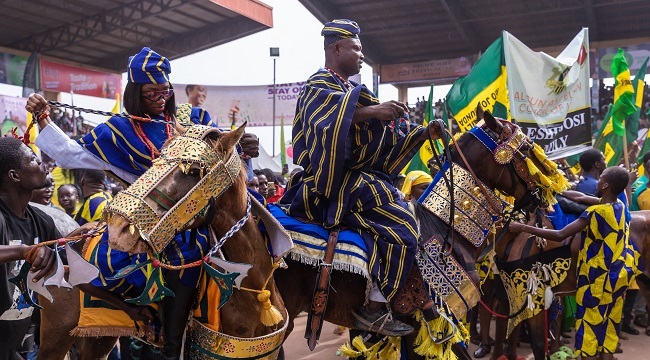
The Awujale Council of Chiefs has declared that the annual Ojude Oba Festival will hold in 2026 despite the vacant stool the Awujale of Ijebuland.
The council insists that the globally recognised cultural celebration is rooted in institutional continuity rather than individual monarchy.
The Baagbimo of Ijebu and Secretary of the Awujale Council of Chiefs, Professor Fassy Yusuf, disclosed this during an interview on Frontline, a public affairs programme on Eagle 102.5 FM.
Commenting on the growing public speculation over whether the death of Oba Sikiru Kayode Adetona could affect the continuity of the festival, Prof. Yusuf dismissed calls for postponement, stressing that Ojude Oba remains a permanent cultural heritage of the Ijebu people.
“Once again, I confirm to you, and I confirm to the whole world that the Ojude Oba festival is holding in May,” he said. “We are talking about institutions now, not about individuals.” he said.
According to him, the absence of a reigning monarch does not invalidate the cultural significance of the festival, noting that historical records already show multiple instances where Ojude Oba held successfully during periods of royal transition or temporary absence of the Awujale.
He argued that linking the continuation of the festival solely to the physical presence of a monarch reflects a misunderstanding of Ijebu tradition and institutional history.
“There were times in the past that a late monarch or a revered monarch was not available due to one reason or the other, and yet the festival took place,” he stated.
Speaking further, he described the call for cancellation of the festival as unnecessary and misleading, warning against attempts to politicise or destabilise an important cultural institution.
“It is inconceivable that anybody will be thinking or clamouring for the cancellation of Ojude Oba festival until a new Awujale is installed,” he said.
He further criticised individuals advocating suspension of the festival, describing them as people disconnected from the cultural identity of Ijebuland.
“All those people talking about cancellation are people that lack self-identity. They are rabble-rousers fishing in troubled waters,” he added.
Prof. Yusuf maintained that Ojude Oba transcends individual reigns and temporary leadership gaps, insisting that the cultural identity of the Ijebu people cannot be suspended because of succession processes.
Citing historical precedents, he recalled that the festival was held in 1959 following the death of Oba Robertson Adesanya Gbelegbuwa before the eventual installation of Oba Adetona in 1960.
“So, his appointment was approved January 2, 1960, and he was crowned April 2, 1960. That was about one year that Ojude Oba was held without any king on the throne,” he explained.
He also referenced the 1995 edition of the festival when Oba Adetona was reportedly receiving medical treatment abroad.
“In 1995, Ojude Oba festival held. Oba Adetona was critically ill and flown abroad, but the festival still held,” he said.
According to him, respected community leaders including the late Ogbeni-Oja Bayo Okuku, Subomi Balogun, and Papa Chris Okunbadejo helped sustain the institution during that period.
Prof. Yusuf dismissed arguments suggesting that the current royal interregnum should halt the festival, describing such reasoning as illogical and inconsistent with institutional governance.
“That is an illogical argument. It cannot withstand the test of logic. It is nonsensical,” he stated.
He explained that an interim administrative structure is already in place to ensure continuity of traditional responsibilities pending the installation of a new monarch.
“We have in place an Awujale Interregnum Administrative Council. The chairman may not be occupying the seat of Awujale, but he is standing in as acting Awujale,” he said.
According to him, governance and cultural activities cannot be suspended because of temporary leadership vacancies, stressing that institutional continuity remains essential.
“Nature abhors a vacuum. Somebody has to stand in,” he added.
Addressing concerns over succession processes, Prof. Yusuf confirmed that the ruling house had complied with provisions of the Obas and Chiefs Law and submitted the required documentation to the kingmakers before the process was temporarily suspended following government directives.
“We have complied with the Oba and Chiefs Law. We have forwarded the list to the kingmakers and they have started working,” he explained.
He, however, disclosed that the family had appealed to the government to allow the succession process to continue.
On allegations of coercion and corruption surrounding the selection process, Prof. Yusuf insisted that no official findings or indictments had been made public.
“These are allegations and they remain in the realm of speculations and accusations. The law says he who alleges must prove,” he stated.
He also confirmed that the Department of State Services invited him for clarification in his capacity as vice chairman of the ruling house but stressed that no accusations were levelled against him.
Turning to preparations for the 2026 festival, Prof. Yusuf disclosed that several reforms had already been introduced to improve logistics, security, communication, and crowd management following challenges experienced during previous editions.
“We set up sub-committees to handle security, communication, traffic, and safety. We have no excuse this time around,” he said.
He added that financial management of the festival remains transparent and institutionally regulated through palace accounts supervised by the interregnum administrative council.
“No cash is paid to anybody. Everything goes through the palace account,” he noted.
Prof. Yusuf concluded by reaffirming that Ojude Oba remains an enduring cultural institution whose continuity must be protected regardless of temporary leadership transitions.
“Even without an installed Awujale, Ojude Oba will hold. It is not about individuals. It is about continuity, identity, and institution,” he said.